
Summer bought alive the welcoming waters of the Richmond Baths opposite Shirley’s house. It offered a shelter both from scorching days under the hot tin roof of Griffith Street, and the tortuous monotony of long afternoons with nought to do but watch the heat hunted birds fight for space on gap-toothed paling fences. When her sister Lorna was happy to she accompanied her, and Shirley swam for hours on end, racing around with the other waterlogged children in baggy second-hand bathers until the late afternoon clouds moved across the smog strewn Richmond sky, and hunger called them all home. Eventually, Lorna had better things to do, but with a bit of begging and whining, May would let Shirley go on her own when she promised not to go in the deep end. This was a heaven-sent escape from the boredom of dangling on the edge of pale garden shadows. Kenny and Lloyd would often join her, and the day would fly by. Food provisions could be a problem, but if Shirley’s father was in a good mood when he was in the kitchen cooking his breakfast of fried bread before he left for work, she could ask him nicely for a threepence for lunch and he would often oblige. Shirley would go there on days that weren’t so warm as well, to watch the swimming club older boys and girls training.
At the end of Summer, Shirley was as brown as a berry, and greatly relieved at the idea that now, finally, she could go to school like her sisters. Her first two years of school were spent with the other scrappy neighbourhood children at the local government school, and these years seemed to pass by without any residual memories. Later Shirley could hardly recall what these large seething classrooms of squirming children felt like to sit in, only that she was expected to get herself dressed and out the door in time before the bell started ringing down the street. Shirley’s hair was something of a problem, being short and unpredictably curly – in the morning it stood on end and resisted any of the lustre that a patient brush could potentially lend. The independence that was required to get her clothes and shoes on and assemble some lunch was the sole focus of her mornings, along with getting herself down the grey streets to school early enough to have a race around the schoolyard before the leg chains of the classroom’s huge desks snapped shut around her.
However, at the end of her second year at the local school, after repeated nagging from Shirley who had befriended many of the St Jimmy’s tribe at the Richmond pool over Summer, it was decided that a better place for Shirley was at the recently opened Catholic primary school just off Bridge Road. It was time to discover the world of St James.
Her father was raised High Church of England by his Irish parents at home on the farm at Samaria in North East Victoria. He wasn’t much of a one for church though; his readings of all the great philosophers and classic authors had caused him to question some of the vanities of religion, and his Sundays were reserved for the worship of the racing horse and the product of malted hops or fermented barley. May, on the other hand, was raised Catholic in Southern Tasmania along with her large family, and was more attached to her faith, so the older girls had attended catholic schools, and it seemed fitting now that Shirley followed suit.
St James, Richmond, stood at the corner of Bridge Road and Hosie Street. It had opened not long before Shirley started school, because the original St Ignatius had become so full it couldn’t cope with the swags of vagabond Irish Catholic families that had flooded into the city from the bush as the economy started to stall, and the small farmers and country businesses were foreclosed upon by faceless bankers. The Sisters of St. Joseph of the Sacred Heart ministered to the educational needs of the poor and pale cheeked children of Richmond. They did so with an inspirational tyranny that fashioned many of the intelligentsia of the public service; the Labor Party factions of the local council, and state and federal government representatives, for decades to come.
School only offered a chequered alternative to the tedium of an empty house and an empty street, but Shirley looked forward to her first day at her new school. Her mother bought her a new pair of dark blue underpants, and a pair of brown leather shoes. Usually, she ran around in a pair of sand shoes faded with mud and the dust of Richmond roads, so she felt quite special putting her new leather shoes on to walk to school on the first day. By then her sisters were both at work, and Eileen walked her up to the corner of Hosie street on her first day and told her to keep walking until she could see the church, and head into the school yard from there. Someone would see her and round her up. She carried her lunch pail clutched like a doll between her hands.
In the school yard, she stood uncertainly in a grainy corner. Dozens of children, all dressed neatly for the first day of school, raced around the tiny, dirt yard. Behind this battered, dusty patch, a small red brick church stood austerely, and behind that a tall building, crested by a cross, towered over the complex peering down at the children through rows of regimented, rectangular, white rimmed windows.
The tiny children amongst the ensemble hugged the school yard fence. Some prep children stood with their mothers, crying balefully. Soon enough, a young nun appeared who rang an enormous ear-piercing bell, and the ragged schoolground inmates screamed and ran to line up along what must have been designated bays. These children soon became completely silent, mollified in some mysterious synchronicity, and were soon marched inside, disappearing into the silhouetted bowels of the school’s halls and classrooms.
The nun, impressively arrayed in the brown and white wimple of the Sisters of St Joseph, called out to all the new arrivals asking them to come forward to the line. When she had ticked off those present, she smiled pleasantly and welcomed them all there.
Shirley noticed her face; it was an angelic blend of plain and beautiful. She seemed so big in her long, brown robes – but later, when Shirley had grown, she realised how tiny Sister Jeanne really was. The new children to the school were told to march into class where they were met by some self-important, older children who took them to their seat at the hard desks. The desks seemed almost too huge to see over the top of, and Shirley was diminutive for her age as it was. She sat forward and craned her head over the top of the desk to look around at the other children.
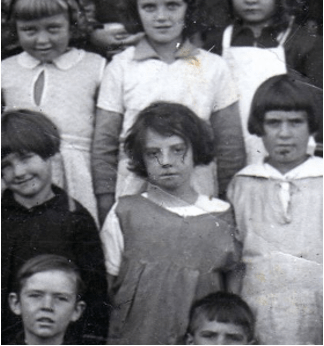
Sitting next to her was a little girl whose face seemed to emit its own light, brighter than the classroom’s murky windows that were shaded by a broken-down fence. She had her hair curled and parted on the side tied up with ribbons, and she was dressed neatly in a blue checked dress with a white collar. She had plump, pinkish cheeks and beautiful blue eyes. Shirley ignored her for the first part of the morning as there was so much to take in.
The top of the chalkboard in the classroom had been decorated with some faded drawings of cats, pixies and fairy princesses in mysterious hues of chalk that it seemed impossible anyone could manufacture, and underneath there was some more writing which Shirley recognised vaguely from her last stint behind a school desk. At the front of the room, there was a raised platform with a solid, wooden desk that ran almost the whole way along. Placed strategically on the desk was a pile of readers, with an impressive wooden yard stick prominently positioned beside them.
Around her persisted the muffled cries of a few determined children, but most of the children were sitting in awed silence, watching everything that Sister Jeanne did. First, she wrote something in deliberate, perfect strokes on the board that she said was her name. She then said to start their first day off they would sing a song; suggesting they all sing ‘Kookaburra sits in the old gumtree’.
Distributing a piece of paper, Sister Jeanne asked the students if they could draw a cat playing in the garden. Each child was given some pastels and in silence they obediently started to draw a terrified cat, in a brick garden.
At this stage the little girl next to her turned to Shirley pretending to admire her dazed, broken strokes and enquired ‘What’s your name?’
“Shirley. What’s yours?”
“My name is Lorna,” the little girl answered – and her whole face smiled.
 Memoirs and Memories