Chapter 9

Chapter 9              The Depression

Life for the folk of Richmond in the first half of the twentieth century was often perched on the very fringe of poverty and destitution. One missed step – and your home, livelihood and scantily stocked kitchen table could vanish in front of your eyes. The worn-out, humble houses that were the only bitter buffer against such homelessness were dark and cold in Winter, airless and suffocating in Summer, and so cramped inside that most of their inhabitants on a sunny day, or warm evening, took the opportunity to escape the stale four walls, and hang over the rusting front veranda of the tiny terraces chatting with neighbours and passers-by for hours about all the news both inside their own homes, and inside others.

News mingled with gossip, both about the community and the nation, filled the streets, while children played in the gutters. By the mid 1930’s everyone had someone close to them who had lost their job and fallen on hard times. Relatives who were employed were expected to provide for those who could not provide for themselves, and new faces appeared in the street – both adults and children – who were the remnants of families who had been parcelled up and sent to live with cousins, grandmas, sisters or uncles with had enough food on the table, and a spare 6 by 3-foot space in a bedroom for a body to sleep.

It provided some excitement for Shirley to catch sight of a new face appearing down the street, and seeing them begin the walk out each morning dressed up in their best attire below clenched jaws in the apparent hope of finding work that day. Strange, glum children also appeared in the street, but they looked odd and out of place, and soon retired back inside their house with their ball or their comic.

In 1937, it was time for the Griffith Street house to take in a waif of its own. Shirley’s little bedroom was barely the size of a pantry and only had enough room for a bed; yet even it was a luxury for a destitute relative. Much to Shirley’s disappointment and gall, a young male cousin, James Kingsley Redding usurped Shirley from her minute, ‘barely a’ bedroom – relegating her to sleep, thanklessly, on the tiny kitchen couch.

Jim was a few years older than Shirley, and took little interest in her, which she returned in spades. It seemed he felt he was facing a great comedown in his status in life, so he rarely deigned to talk to Shirley out of either shame, embarrassment, disdain or just simple shyness. Looking uncomfortable and out of place, he spent a lot of time in his tiny room reading comics and counting his marbles, or went walking out of Griffith Street, returning many hours later just in time for dinner. His father visited most Sundays, and together they would eat lunch with May and Arthur, and then go for a walk to the park to get James out of the house. His father would bring a bag of lollies for his son as a special consolatory treat, and Shirley was greatly chagrined that she never got to so much as sniff one of those lollies during his whole stay, even though her uncomfortable nights on the couch should have merited at least a small tasting each Sunday. Eventually, Arthur got Jim’s father a job and the whole family moved to Windsor; Shirley rejoicing when she could move back into her own pokey little room again.

Chapter 10 Polio

In the November of 1937, a time of darkness fell on the streets Richmond, much like the war would in later years, but this time it was war with an invisible enemy. It didn’t have a nationality, nor was it centralised in faraway locations around the globe that only lived in black and white on the front of screaming newspapers. This enemy attacked the bodies of unsuspecting children and young adults, striking at random, and bringing down the healthiest in Richmond’s community.

Polio.

The name conjured up nightmare pictographs of children confined to beds, with their legs or arms, or both, stuffed into cruel splints. Large wards of them were captured crammed together, looking dolefully at tiny toys plonked on their bed to brighten up the shot. The papers were full of dire warnings, and growing concern until the outbreak was named an epidemic, and the schools were closed weeks ahead of the usual summer break. Children lurked around their homes, forbidden to leave or wander around the streets as they usually did. Even the swimming pool in Griffith Street had closed due to the panic. It was a long, boring and frustrating Summer spent trying to find something to do. When May sent Shirley to do messages up Bridge road, she stuffed her nostrils with cotton wool so she wouldn’t catch the deadly germ.

May decided that they would never get through the whole summer cooped up inside the house with Shirley, so plans were hatched to send Shirley away to the country for the Summer, where she could avoid the large crowds. In the bush, Polio might not have raised its terrifying hand against the innocent quite so savagely as in the seething slums of Richmond.

Dated September 9, 1937

Source: Trove 25/8/21  https://trove.nla.gov.au/newspaper/article/11091971

Chapter 10 Country relatives

May grew up the baby of a large Catholic family domiciled in the southeast of Tasmania, which was where she met Arthur working as a young, trainee shipping clerk for the Tasmanian orchard industry that practically ran the bustling town of Franklin. It was based on the majestic Huon River opposite the Herighty family home in South Franklin. Shirley grew up hearing the family legends involving the tribe of faded faces that sat on the mantelpiece in the loungeroom, and occasionally one of the phantoms would appear for a week or two for a visit, having made the trek to the mainland for a special event, or as part of their work.  At regular intervals, May would announce that a new ‘present’ had arrived from her relatives – often her generous older brother – who was attributed with the gift of a very impressive fur stole (although Shirley suspected in later years that it was just rabbit skin) that was May’s pride and joy. Her mother would disappear down to Tasmania for weeks or what seemed, at times, like months to visit her relatives from the time that Shirley was around five. Letting herself in after various after school adventures, she would sulkily wait for one of her sisters, or her father to arrive home and cook her dinner. Even though her mother was often locked in her room for most of the day, the house still felt empty and cold when her mother wasn’t there, and Shirley took solace in playing with the radio and making a mess of her comics in the front room when she spent many hours alone.

And so that both Shirley and May did not go quietly mad during the polio isolation, it was arranged that ten year old Shirley would be sent to stay with May’s older sisters in Hobart and South Franklin. Shirley was quite fascinated at the idea of such an expedition and meeting the women who belonged to the blurred faces in the photos in her mother’s room. Early in January she was organised a passage on the overnight ferry to Devonport and was packed ready to go. A list of instructions on how to make the change from the ferry to the train, and where to wait after she had alighted the train in Hobart, were attached to her luggage. She was given two plum puddings and a few other small presents for her aunties, and as the mild January wind whirled around the blustery jetty, her mother gave her last minute messages before she boarded the rather rusty, enormous looking Bass Strait steamer Nairana, feeling very cold and tiny.

The rolling of the waves and the endless grey ocean seemed a very lacklustre start to the holiday. However, the ocean was reasonably calm, and after an exciting night in her very own bunk, and a packed breakfast with a glass of milk from the tiny cafeteria, a tall ship attendant walked Shirley to the directly adjacent train platform carrying her bag for her, and the final stage of her journey began. The tiny, shuddering train seemed to be filled to overflowing with mothers and fractious babies, and smelly men dressed in ill-mended trousers and oversized coats. Shirley crammed into a corner and tried to take an interest in the fields and cows outside the train window, until that became too monotonous, and she started counting each time she saw a cow or a sheep.

After what seemed an eternity, the little rickety cottages on the outskirts of Hobart appeared like stone flowerets on hilly green fields, and the train finally shuddered to a holt. Deposited on the Hobart Station platform clutching her bag and coat, Shirley felt bewildered by the crowd, but finally a kindly lady bustled up to her and took her hand. Her godmother Auntie Kitty Caine, a staid old chook whose husband had died before they had any children, greeted her with a big kiss and a dozen questions about how her trip had been. They returned to her house in a horse and jinker in a quiet outer suburb called New Town. Auntie Kitty’s miniature house was framed by an equally elfin sized front yard crammed with convivial looking flowers, and a wonderful smell of stew and cakes drifted from the pint-sized kitchen. Apart from luxuriating in the endless feeding times, including morning and afternoon tea, there wasn’t much to do in New Town. It was a sleepy hollow that echoed with brown bees humming, and the placid flapping of washing lines against geranium hedges.

Luckily, within a solid Richmond walking distance, lay a beach called Sandy Bay. When the sun came out and the temperature held a tinge of heat, Shirley would trek down to the beach and brave a swim. The harbour was so beautiful with the beating wings of seagulls framing the cerulean blue. The hills of Hobart in the distance were grey navy peaks sprinkled with picturesque houses ranging from tiny white specks to imposing stone mansions hogging the views. It looked so inviting, until her toes hit the crystal water and turned to stone. Not to be deterred, Shirley eventually completed an arctic swim and found a patch of beach out of the breeze to shelter in and try to raise her body temperature to an acceptable level, before walking home again.

They went into see Hobart city one day which to Shirley, accustomed to the squirming metropolis of Melbourne, seemed like a dowdy old country town with nowhere interesting to fossick around in. The highlight of the whole visit to Hobart was the fascinating tour of the Cadbury factory. Well, to Shirley ‘fascinating’ equalled ‘delicious’. There were great handfuls of chocolate available at the door and Shirley was almost giddy with sugary pleasure by the time the tour ended.

Next, she was sent down to Franklin, where her mother had grown up. She was to stay with May’s eldest sister Mary, who was a much merrier soul than Auntie Kitty and overrun with children and grandchildren. There was much more fun to be had there, and again plenty of opportunities to eat! South Franklin was beautiful. The gentle, rolling hills were capped by arches of lavish, dark-green trees overhung by an ever changing blue, grey, pink, and lavender sky that went on forever. An enormous river as big as the sea – the Huon- dominated the landscape and flowed by profoundly just across the road from her auntie’s and cousin’s house. Large boats and colourful barges ferried the orchards of apples and the Huon pine from the nearby forests, and small fishing rigs were always busy feeding the locals. There were glorious walks that she undertook with her cousin’s children. There were relatives everywhere! Auntie Mary’s daughter Rebecca lived next door, and they were always visiting and wiling away the summer afternoons riding the horses, playing cricket in the backyard paddock, or walking into town to buy a milkshake from the general store. Night times there were epic card games, where a box of matches became the currency of champions, and sly machinations of outbidding and out-bluffing opponents caused much hilarious chagrin. For a special treat on a Saturday, they would walk into town and go to the pictures at the Palais Theatre. It was a busy town, thriving even in the midst of the depression, and polio was a very distant threat indeed down on the Huon.

Rebecca’s two older boys Les and Phillip Oakford were particularly kind to Shirley. They were handsome young boys, and although too old to play with Shirley, they let her in on the cricket games with them sometimes in their enormous backyard.

The Huon River at Franklin, September, 2018

Some three years later Shirley was to meet her Tasmanian cousins again. Both Phillip and Les had enlisted in the navy and did their training at HMAS Flinders. Les, the older brother would spend his leave at Griffith Street, welcomed into the house by May and Arthur, as he was a bright young lad, with an easy smile and a very polite manner. He left to do his maiden voyage on the HMAS Sydney in and around the Pacific during 1940-1941. Arthur would read them extracts of the newspaper that spoke of the exploits of the Australian Navy, particularly HMAS Sydney. In the Spring of 1941, Les came off the ship and his brother Phillip got on. A few months later on November 19, 1941, the ship encountered ‘The Kormorant’ off the Northwest coast of Australia and was sunk with the tragic loss of all 645 souls on board. It remains Australia’s biggest naval loss of life, and one of its darkest days. May went to Tasmania and stayed for much longer than usual that year.

Tasmania filled up one summer. Later that year, Shirley ventured up on the train to Myrtleford to stay with her father’s sister Auntie Lillian. She was a dedicated single woman, who neatly managed Shirley’s day with dainty flower lined plates of toast for breakfast, and lunch pails left on the table full of jam sandwiches, and homemade cakes topped with icing. There were bags of fruit too. Nectarines juicy from the country sun, and melons dripping with sweet water and pips. The tiny cottage Auntie Lil lived in was ringed by a cheery flowerbed and trees that shaded the verandas keeping the high-country sun at bay. After a morning and early afternoon at the tiny local council pool, splashing and making friends with some of the local divers, Shirley would stagger up the main street in the blaring heat to her auntie’s shop, where the walls were stacked from top to bottom with what seemed to Shirley to be every imaginable fabric, thread, button, wool, haberdashery accessory and basic clothing item imaginable. Auntie Lillian served customers who stopped by for a long yarn or a hasty chat, with new stockings, lace handkerchiefs, packets of new buttons for a child’s dress, hooks and eyes, underwear or farmer’s work pants, while she deftly swung a large and well-worn timber ladder around the walls to the exact drawer or shelf that housed the sought-after items, clambering up the steps like a girl half her age. The owner of the shop was often in attendance supervising the register and writing up lay-by payments in a large, darkly thumbed docket book, and he would greet Shirley cheerily and invite her into the tea room for a drink and some Nice biscuits, which felt like the lap of luxury for her. The tiny tea room was usually cool and refreshingly gloomy after the bright sunlight of the main street and Shirley would busy herself there scribbling on old receipt books, or be tempted out to stand out of the way behind the counter while her auntie served the country customers, and introduced her niece to the friendly folk.

Occasionally, Shirley ventured out the back garden and down to the creek that ran through the rear of the town. The sun beat down through the shade of the trees, and when it touched your bare skin it almost sizzled as the heat greedily dried up the sweat beads, grasping at squinting eyes. Yet as soon as her toes touched the water flowing down from the Australian Alps, the hairs on her body stood back in horror, and she gasped through gritted teeth at the clear icy eddies. No matter how hot she was, she could only stand the water up to her thighs before she had to head out again and sit stinging on the shore, practising her rock throwing when none of the other village children were attempting the same suicidal idea of ‘cooling off’ in the deceptively pretty waters. The forest floor glittered around her with drops of scalloped sun, and the leaf spilt air smelt like it had been pressed from inside the trees through a sieve of wind. It was a beautiful place to visit after the grubby, grey of Richmond streets, and to be indulged with special treats to eat was always a sure way into Shirley’s heart. She loved visiting her Auntie Lil. 
Chapter 8 Summer

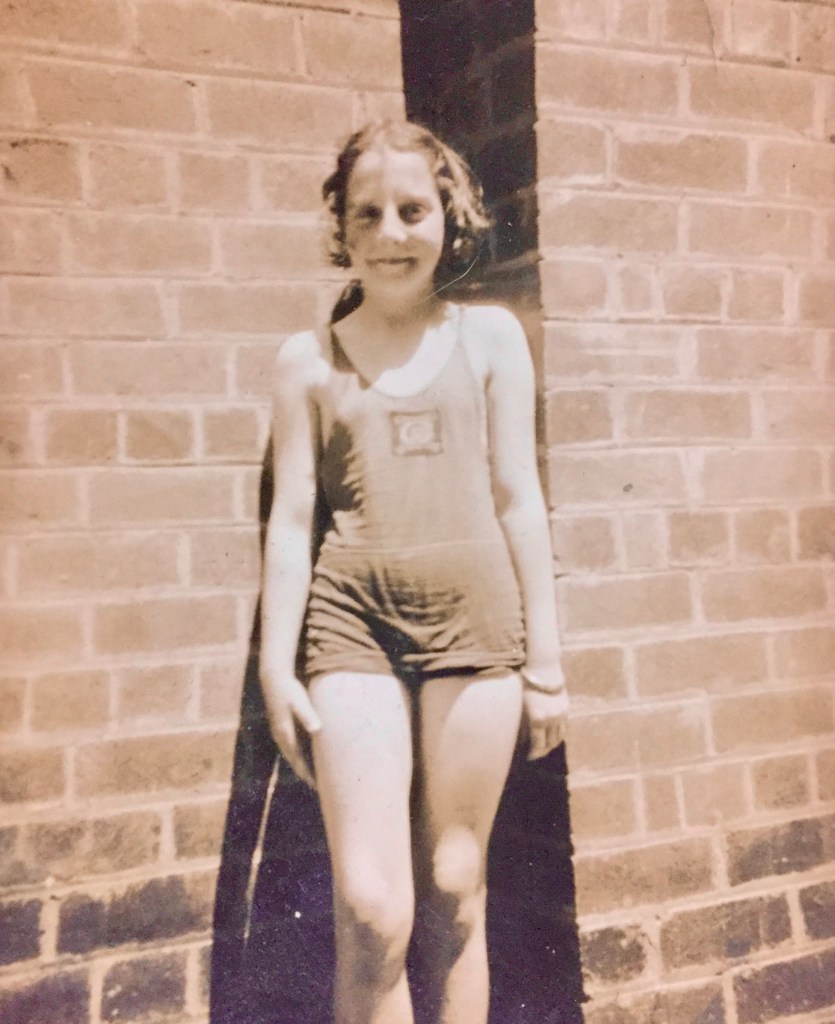
Shirley at Richmond Baths

Summer Holidays

At home the Summer between school years usually passed agonisingly slowly. Shirley, at eight years old, was allowed to head to the Richmond Swimming Pool whenever she pleased, if she organised the admission money with her father beforehand. The diving squad in Richmond was a popular club, and children of all ages flocked there and lined up to show off their most graceful dives for the coach, in the hope of being selected for the regular inter-club competitions. Shirley had a natural ability at diving, and her tiny frame made for a slick and graceful entrance into the pool. It may have had something to do with the countless hours she spent at the pool mornings and afternoons, and on stinking hot Summer nights, but Shirley developed some of the best diving ability for her age range.

On days when she couldn’t go to the pool, or when even the swimming stalwarts did not want to brave the weather, she still hung around with Kenny and Lloyd Gill even though it was becoming a bit embarrassing at times to be seen playing with boys. Shirley didn’t really care what anyone said, as she was a tomboy at heart and loved racing around with the Gill boys, climbing fences and throwing overripe apricots at the disaffected, feral cats perched on neighbourhood roofs.

Summer holidays also bought the plum pudding season, and Shirley would sit on the bench in the laundry and watch as her mum hung up the dozens of plum puddings that she made for Christmas Day, lamenting that all this time, effort and sugary stuffing was going into, what was to Shirley, such an inedible treat. Most of them were given away, as May was considered the family expert in the plum pudding department. The rest were kept as desserts for the Redding household until the following Easter, when on Sunday the last precious morsel of plum pudding would be devoured. Shirley never knew what all the fuss was about and preferred to eat the brandy custard and cream on its own.

Christmas Day itself was a quiet family affair when Shirley was a child. Her grandmother Sarah would catch the train over and eat lunch with May, Arthur, Eileen and Lorna. Eventually the older girls’ boyfriends would appear later in the day. However, usually it was a long boring day, punctuated by an early snoop around the makeshift Christmas ‘bush’ for a practical present or two (new blue underpants, some socks, perhaps a small hand knitted cardigan, a new pair of swimmers, a bag of lollies or a comic). This was then followed by a ‘feast’ involving the pet duck who had resided in the backyard for at least 10 months of the previous year. Shirley was never able to eat duck again after she moved out of Griffith Street. If the weather so decided, the tin roof could turn the tiny house into an oven and Shirley empathised with the duck even more.

After lunch, her father then retreated into the library for an extra-ordinary session of Christmas port wine, and the women folk would be relegated to listening to the ABC radio station in the lounge-room, and all would seem very lacklustre until Uncle Tom turned up around 3pm. On hot days of course, he did not venture out for fear of boiling his lady wife in the front seat of the Buick, but if it was a nondescript summer day – a cool breeze dancing with the dehydrated hydrangeas – he would come over to celebrate some Christmas spirits with his brother Arthur. There was always a present from Uncle Tom and Auntie Lillian that was more exciting to unwrap than to ever make use of – a little trinket such as an embroidered hankie, or a pair of gloves, and then the day returned to deafeningly boring dreariness. Later the street outside might offer some chance of admiring a new acquisition of one of the neighbourhood children, if they weren’t seconded into a day of relatives on the other side of town.

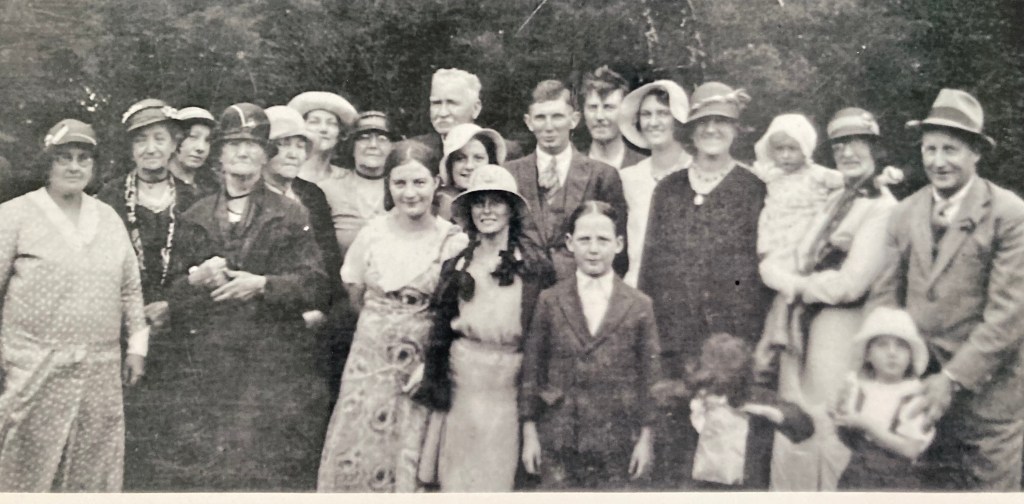
After Christmas Day was over, there was a traditional Boxing Day picnic involving her Redding family relatives; her grandmother, jolly Uncle George who made the gruelling journey down from Beulah when he was alive, Auntie Kathleen who resided with George since the depression, Tom and Lil of course, and Arthur’s sister Lillian who would come down from Myrtleford on her Christmas leave to visit all the family. Shirley’s numerous cousins from her dad’s side would turn up too, as well as Uncle Harold who worked for ‘The Argus’ alongside his poker faced, besuited boys, and young Uncle George and his son James Redding (whom he idolized) who at 12, haughtily loitered around the picnic table in a grown man’s suit and a starched collar, with his hair slicked down and parted in the middle, barely cracking a smile the whole day

The family picnic. Shirley right front with her head stuck in a bag of lollies. Above and to her right are Auntie Lil and Uncle Tom. Her father is at the back in the centre without a tie. May is third from the left at rear.

The tribe would usually head either to Yarra Bend Park or the Botanic Gardens for the day. Everyone would dress up in their best formal gear and summer hats, and hike into the gardens laden with scones, cupcakes, leftover pudding, lemonade and tea caddies. The younger kids would tear around chasing seagulls and ducks, playing tiggy or cricket, and the adults would catch up on what all the folk in Samaria or Benalla or Deniliquin were doing; who had had a baby, fallen sick, or succumbed to yellow jaundice; who had fallen on rough times in the bush and the city, and what had become of them. Arthur would come along under sufferance, as he hated staying sober and wasting a day off, but it provided him with some interesting conversation with Tom and Uncle George and oftentimes a sip or seven of port wine which helped ease his discomfort. He always looked the wild man though, with his collarless shirt and his unbrushed hair. He refused to parlay with any of the niceties of formal grooming on a Sunday or holiday, as it was his philosophy that with no conventions to care about, he was free to dress as he pleased. No one took any notice however, because he had been doing it for years.

Shirley found it hard to play with her male cousins. They were a bit more standoffish than Kenny and Lloyd, and more overdressed. They usually just hung around the men in their ill-fitting suits or played cricket with a boy’s only air. Her main activities were scouting the picnic table for any extra special titbits like boiled lollies or Marella jubes.

As the afternoon faded and the shadows grew strong, the family would gather for a photo from Uncle Harold’s Brownie camera, and the crew would wander back up to the street to catch the bus home.

The rest of January was spent at the pool, roaming Bridge Road in search of school friends, visiting Lorna and playing with her brothers, or as a special treat, an afternoon expedition to the Port Melbourne Pier with her mother, where Shirley would wade into the water and prise off the fattest mussels she could find. She would tuck her skirt into her undies and stagger from pylon to pylon, purloining huge bagfuls of sweet shellfish that she and her mother would take home, boil up and gorge themselves on.

Special Friday nights sometimes occurred when Arthur would suggest that Shirley meet him after work at his office on the corner of King’s Street and Flinders Street where he worked for a Shipping Agent. Her mother would walk her to the tram on Bridge Road, and she would ride into town with a composed air of self-importance that a day of visiting her father’s office imbued her with. Once she arrived, she headed through the heavy panelled doors and up two flights of stairs where the secretary at her father’s office greeted her with her ever-so-twinkly receptionist voice. She smelled of lavender and cigarettes, and her stockings rustled under her knee length, heavily pleated skirt as she ushered Shirley into an elevated seat behind one of the spare typewriters. There, Shirley would tip tap away at her secretarial memos until the keys would jam and ‘Margaret’, or ‘Joan’ or ‘Melva’ would have to save them. Various workers would wander past, counting down the minutes to knock off time, and stop for a chat and a cigarette with Shirley and ‘Muriel’, leaning heavily on the mail counter, until they sauntered off down an awfully important looking dark panelled corridor back to their mysterious doorways. After swinging on the chair and typing a sheet or two of gibberish, her father would appear, and rescue ‘Maude’, and together they would head out into the blinding sunlight and breathe the bustling Flinders Street air.

From there the pub crawl would begin.

The first establishment was a mere half a block away. Shirley would be deposited in the stale smelling ladies lounge with a lemon squash and a cracked bowl brimming with biscuits and cheese. A few women sat smoking in the corner with their hats curlicued with wisps of cigarette smoke. Cheerful barmaids always looked out for Shirley, greeting their father with cackling grins through crooked teeth. When the first drink and bowl of crackers was finished, her dad would soon reappear, breathing beer and jollity, and they would make their way down to the Duke of Wellington where the men spilled out of the public bar on to the street at peak hour. The Ladies’ Lounge was crowded at the ‘Duke’ and the bar was crammed with a group talking raucously, hats jiggling amid tottering cigarette ash. A vicious round of laughter sometimes erupted from the far end of the bar, and Shirley would feel very small on her stool as the Friday evening frenzy started to take hold.

Arthur’s favourite pub was the ‘The Town Hall Hotel’ on the corner Lyndhurst Street and Bridge Road where he always ended his evening with the ‘Six O’clock Swill’, so at Russell Street Arthur would raffishly toss Shirley a sixpence so she could dart up Russell Street to Bourke Street just in time to order one of the last serves of Fish and Chips and chocolate milk from Coles’ Cafeteria, after a quick fossick through the ledges of trinkets on the ground floor.

Full of sugary drinks and salty treats, Shirley would squeeze into a small hollow between lurching bodies on the tram home, sometimes finding her mum waiting at the stop at the top of Griffith Street where May was audience to her recount of city adventures and which pubs her father had taken her too. Occasionally there were a few extra pennies for Shirley to buy a comic or two. An exciting afternoon all in all.

 Some Friday nights though, after an early mark from work that enabled the inclusion of even more corner pubs en-route to Griffith Street, the pavement home ‘wasn’t wide enough’ for Arthur, and later – raised voices and the dismal sound of staggering footsteps and cursing crept creaking up the hallway to Shirley’s room.

Chapter 6 and 7

Sister Alfred – Surviving Grade 3 and other adventures

Education for Shirley became both a warm world of friend-led excitement, and a dark fortress of confusing concepts and mind-numbing directives. Arriving at school, having dressed herself in a dishevelled heap of ill-fitting clothes, her hair a mess of frizz; her shoes scuffed and often on the wrong feet; she looked a ragamuffin next to Lorna with her perfect bows – which dismayed her at first until playtime, when bows or no, fun with her friends was the only thought on her mind.

The lessons of letters and numbers were tortuous, dull and unwieldy. The readers were the same every day, and from the first day they were read, they were already boring, so by the Winter term, it was much more fun to joke with the children around her and poke them into a bit of repartee to keep the boredom at bay. Eventually Sister Jeanne got sick of the interruptions, and she told Shirley to sit with the boys to thwart her socialising. Booa Randal sat in front of her, and she liked to annoy him by kicking his heels when she could reach them, in the hope of causing a bit of hilarity. Jackie Charity, with his whipper will, spiky red hair, and his starkly white face spotted with large brown freckles, sat to the right of Shirley and, much to her profound gratitude, provided a litany of jokes under his breath that gave Shirley some well-earned relief from the stultifying haze of instructions and ultimatums that were levelled at the squirming members of Grade 2 in the Richmond slums in 1933.

Shirley thought that her first few years of school were barely worth a comment when her mum and sisters, or Uncle Tom, enquired. However, these years soon took on a halcyon glow when Shirley and her motley compatriot crew reached Grade 3. There they met a nun called ….Sister Alfred! It was enough to strike terror in the heart of the most hardened gangster parading around Richmond in his spats, cane and high hat. To be taught by Sister Alfred was to know a very ‘particular’ fear, as well as the awful, unpredictable certainty that one day it will be you that is caught doing something that you never planned to be the wrong thing to do. It was then, like a lightning bolt the fates aligned and – suddenly – She was there – towering over a child half her height with a large yard stick twice theirs, and a face as black as Celtic thunder. She was terrifying.

When someone, somehow, had a death wish and talked out of turn, or dropped a pen at a crucial moment, or sniggered at the stupid answer of the lice-ridden clutz in the back row, Sister Alfred would randomly select an aisle to run through, brandishing her yard stick like a light sabre, and wack it down a the desk within an inch of the pinkie of a white faced child’s hand so hard, that it would have needed microsurgery, tragically unavailable in the 1930s, to reattach it. Incredibly, she never touched a single digit on a child’s hand during such a parade, but she certainly counted an astronomical number of numbed fingers as her digital victims in her front of class line-ups as a meek educator for the Sisters of St. Joseph of the Sacred Heart. A concentration camp prison officer would be in awe of her style. She was magnificent.

Chapter 7

The Fairies’ Tree

Being a lonely child of Richmond in the 1930s meant that the streets sometimes were your only companion. When there was not another skinny, windswept, sun-hunted child in the neighbourhood to be rounded up to play with, all that was left was the occasional glimpse of companionship from the community’s streets. The comforting chatter of the horse and jinker, the bellicose busyness of a fume breathing automobile on an errand to more exciting events, and the friendly importance of a crowded tram sending and receiving passengers were more interesting than an empty kitchen and a silent garden. Wandering along Griffith Street into Bridge Road and choosing which direction to head once she got there, was a flip of the coin. Shirley most often took off towards the city as if it were a magnet. The city offered the parks and gardens, the shops and grandiose buildings, purposeful crowds and the excitement of the company of strangers. In 1932, when Shirley was 5, she discovered the fascination of what was evolving in the shady centre of the Fitzroy Gardens where the Fairies’ Tree was under construction by the philanthropic artist Ola Cohn. She happened upon her one day, while she was with Kenny and Lloyd Gill meeting their father after he finished his job as the doorman of the Windsor Hotel. They all watched in quiet abeyance as a woman who looked very much like their own mothers, but strangely wielding a chisel and mallet, tapped gently away at the trunk of the tree. After that first encounter, Shirley headed there every chance she got when the social life of Griffith Street was insignificant, and even when it wasn’t, to see if she would find this fascinating lady in attendance, and the figures in the tree more prominent.

The fine detail of the magical creatures that she created, seemed effortless to the incongruously dowdy lady sitting on her stool next to the tree in all sorts of weather. Even though she looked like everyone’s mum at home minus the apron, chiselling away a tree trunk was not in the list of chores that the mums she knew ever considered an appropriate activity. Who she was and how she came to be transforming the tree trunk in such a way, was a fairy tale mystery in itself to Shirley. Once Lloyd, who was older, summoned up the confidence to ask the lady what she was doing, and she told them very kindly about the fairies’ tree she was creating for the children of Melbourne. She explained to them that in London there was an even bigger and more beautiful tree called the Elfin Tree and it was full of magical folk playing and going about their business. In fact, the real magic of the tree was that the elfin folk came alive at night when the park was empty. Once a human approached, they would quickly scurried back to their poses. The only people who could ever have the rare chance of seeing the fairies moving were young children, because the magical folk knew that children still believed in them. So, if they were very lucky and very quiet and kind, the fairies might let them see them alive!

Shirley went back there even as a mother herself – remembering the story, and half expected to see those little figures begin moving at any minute.

Chapter 5 – Life with Lorna

Richmond Park 1935

School days soon seemed to pass much the same monotonous way as long days at home had; there were just with more kids to play with. Sister Jeanne led them through an agonising adventure of seemingly endless lists of words, and complicated letter formations, which they were required to copy over and over into their exercise books. Pen stains bled into their hands and on to all the wrong places in their books. Stodgy stories were read about well-dressed children who played with obedient cats and dogs, and always seemed to be getting taken out to strange, formal places by vaguely cheerful mums and dads, who also wore fancy clothes and sported perfect hairdos. Shirley could hardly breathe beneath her boredom.

Play time was the best fun.

Her and Lorna would tear around the playground chasing the boys from Lorna’s street, or they would roam around arm in arm with some of the other girls; Clarice O’Brien, Kathleen O’Connor and Mary Scully, and sing the songs that Sister Jeanne had taught them. Out in the yard at lunch, a fascinating game of ‘Witches’ evolved. Next to the convent, between it and the school, there was a wire fence, and a small walkway between the two provided the stage for vulnerable young children to gleefully encounter an evil ‘witch’ who would try to catch them, if they were not quick enough to dash away from her deathly claws, screaming fit to raise the ghosts of the homeless drunks sleeping blocks away in Survey Paddock.

It was a favourite game of this scruffy bunch of poor Irish Catholic children; the rules involved the ones that were caught turning into witches making the game thrilling and terrifying in all the right ways for desk jaded children at lunchtime. Shirley was a garrulous and vivacious child always looking for fun and a laugh as was Lorna, and they were always dead in the middle of a large gaggle of eager, knee-skinned kids.

Back inside the classroom after lunch, usually it was back to more copying, but if the witch magic from lunchtime worked and it was sunny sometimes they were allowed to sit outside and listen to a story. Sister Jeanne would occasionally ride out the last hour before the end of school with some old paper set aside for drawings and she would bring out huge tubs on broken pastels and pencils, and ask the children to stencil patterns on paper and colour them in in silence. The end of day bell was a joyful sound.

After any given agonising day like this, Shirley would walk half the way home with her friends and the last few blocks on her own, where she would find her mother usually locked inside her room, if she wasn’t on one of her extended visits to Tasmania. There was nothing to eat in the house. No matter how hungry she was after a long day at school, there wasn’t a single morsel of food in the house, except what was planned for dinner that night. Shirley’s stomach would do a backflip and land in her head, so that all she could think about was how hungry she was and how long it was before dinner. Sometimes she wandered off down to the Gill’s or Margaret’s house, but quite by chance one day, while she was walking past the local Methodist church, she was invited in with the promise of cordial and biscuits. That was more than enough enticement for Shirley, and this last resort became a haven for her. The folk there were always pleased to see her and knew her name. They asked her to pray with them sometimes, which she felt was a bit of an imposition, but most of the time she sat with them quietly while they all knelt and prayed.

By Grade One and Two, Lorna and Shirley had become the best of friends and her happiest days were when Lorna asked her to back to her house for a play, and her mother Gertie, would greet them with a tray of scones, or sweet biscuits. It was heavenly. They would sit around the table and gorge themselves on the delicious treats and then head outside to play with her tribe of brothers in the large, friendly garden. It was like a wonderland of fruit trees and roses and overgrown geraniums and hydrangeas. The chook pen was held together with a few bits of wire and uncertain palings, but even the chickens seemed happy at Lorna’s place. They would spend their time with Lorna’s enthusiastic brothers, playing hidey, or poison ball or ‘What’s the time Mr Wolf’ until Mr Boland would get home and it was time for dinner.

Lorna’s father was an impressive figure with an equally impressive pot belly. He was always immaculately dressed, even in Summer, with a shirt, tie and brown crimplene vest. His face was as red as a cherry, and as round. His bald head gleamed with a sheen that a shoe shiner would have been jealous of. He filled the house with his voice, energy and presence, yelling for his dinner to be served to him on his metal tray table in the leather throne in the front room where he spent all his time. This was the cue for Gertie to run hurriedly around the house, bent over and urgent, yet smiling beatifically, while bringing him a range of things from tea, to whisky, to slippers, to beer, while she valiantly tried to finish dinner for the seven of them in time. Mr Boland was an SP bookie and his main form of reading was the racing guide, and that was the sole focus of his reading around the clock, seven days a week, every day of the year. He also loved a whisky too, and Shirley always associated that peculiar smell of whisky stained newspaper with Lorna’s house. But she also associated jollity and love with the kitchen of that house, there was laugher in the air, laughter and generosity – something that was somehow absent from her own.

And Lorna … Lorna was a creature of sparkling eyes, and rosy cheeks and conversation and light – who made Shirley cackle constantly with a cascading, infectious, out loud laugh. She trained Shirley how to laugh – and it became a duet of laughter, punctuated by Lorna’s sunny voice making humour out of the everyday. Lorna always made Shirley feel full of joy when she was around her; she made her feel as if everything was sunny and bright in the world, no matter how many whiskies her dad had had, or how many times he yelled at Gertie from the front room to fetch him his needs. As she left their place for Griffith Street, that happy go lucky feeling ebbing weakly away, she would blink up into the greying Richmond sky and breathe its grubby air, knotting her fingers against the cold, Spring wind … and wish that she could stay at Lorna’s forever.

Chapter 4 School days

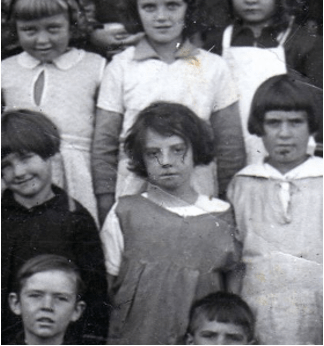
Shirley is fourth from the left in the front row

Summer bought alive the welcoming waters of the Richmond Baths opposite Shirley’s house.  It offered a shelter both from scorching days under the hot tin roof of Griffith Street, and the tortuous monotony of long afternoons with nought to do but watch the heat hunted birds fight for space on gap-toothed paling fences. When her sister Lorna was happy to she accompanied her, and Shirley swam for hours on end, racing around with the other waterlogged children in baggy second-hand bathers until the late afternoon clouds moved across the smog strewn Richmond sky, and hunger called them all home. Eventually, Lorna had better things to do, but with a bit of begging and whining, May would let Shirley go on her own when she promised not to go in the deep end. This was a heaven-sent escape from the boredom of dangling on the edge of pale garden shadows. Kenny and Lloyd would often join her, and the day would fly by. Food provisions could be a problem, but if Shirley’s father was in a good mood when he was in the kitchen cooking his breakfast of fried bread before he left for work, she could ask him nicely for a threepence for lunch and he would often oblige. Shirley would go there on days that weren’t so warm as well, to watch the swimming club older boys and girls training.

At the end of Summer, Shirley was as brown as a berry, and greatly relieved at the idea that now, finally, she could go to school like her sisters. Her first two years of school were spent with the other scrappy neighbourhood children at the local government school, and these years seemed to pass by without any residual memories. Later Shirley could hardly recall what these large seething classrooms of squirming children felt like to sit in, only that she was expected to get herself dressed and out the door in time before the bell started ringing down the street. Shirley’s hair was something of a problem, being short and unpredictably curly – in the morning it stood on end and resisted any of the lustre that a patient brush could potentially lend. The independence that was required to get her clothes and shoes on and assemble some lunch was the sole focus of her mornings, along with getting herself down the grey streets to school early enough to have a race around the schoolyard before the leg chains of the classroom’s huge desks snapped shut around her.

However, at the end of her second year at the local school, after repeated nagging from Shirley who had befriended many of the St Jimmy’s tribe at the Richmond pool over Summer, it was decided that a better place for Shirley was at the recently opened Catholic primary school just off Bridge Road. It was time to discover the world of St James.

Her father was raised High Church of England by his Irish parents at home on the farm at Samaria in North East Victoria. He wasn’t much of a one for church though; his readings of all the great philosophers and classic authors had caused him to question some of the vanities of religion, and his Sundays were reserved for the worship of the racing horse and the product of malted hops or fermented barley. May, on the other hand, was raised Catholic in Southern Tasmania along with her large family, and was more attached to her faith, so the older girls had attended catholic schools, and it seemed fitting now that Shirley followed suit.

St James, Richmond, stood at the corner of Bridge Road and Hosie Street. It had opened not long before Shirley started school, because the original St Ignatius had become so full it couldn’t cope with the swags of vagabond Irish Catholic families that had flooded into the city from the bush as the economy started to stall, and the small farmers and country businesses were foreclosed upon by faceless bankers. The Sisters of St. Joseph of the Sacred Heart ministered to the educational needs of the poor and pale cheeked children of Richmond. They did so with an inspirational tyranny that fashioned many of the intelligentsia of the public service; the Labor Party factions of the local council, and state and federal government representatives, for decades to come.

School only offered a chequered alternative to the tedium of an empty house and an empty street, but Shirley looked forward to her first day at her new school. Her mother bought her a new pair of dark blue underpants, and a pair of brown leather shoes. Usually, she ran around in a pair of sand shoes faded with mud and the dust of Richmond roads, so she felt quite special putting her new leather shoes on to walk to school on the first day. By then her sisters were both at work, and Eileen walked her up to the corner of Hosie street on her first day and told her to keep walking until she could see the church, and head into the school yard from there. Someone would see her and round her up. She carried her lunch pail clutched like a doll between her hands.

In the school yard, she stood uncertainly in a grainy corner. Dozens of children, all dressed neatly for the first day of school, raced around the tiny, dirt yard. Behind this battered, dusty patch, a small red brick church stood austerely, and behind that a tall building, crested by a cross, towered over the complex peering down at the children through rows of regimented, rectangular, white rimmed windows.

The tiny children amongst the ensemble hugged the school yard fence. Some prep children stood with their mothers, crying balefully. Soon enough, a young nun appeared who rang an enormous ear-piercing bell, and the ragged schoolground inmates screamed and ran to line up along what must have been designated bays. These children soon became completely silent, mollified in some mysterious synchronicity, and were soon marched inside, disappearing into the silhouetted bowels of the school’s halls and classrooms.

The nun, impressively arrayed in the brown and white wimple of the Sisters of St Joseph, called out to all the new arrivals asking them to come forward to the line. When she had ticked off those present, she smiled pleasantly and welcomed them all there.

Shirley noticed her face; it was an angelic blend of plain and beautiful. She seemed so big in her long, brown robes  – but later, when Shirley had grown, she realised how tiny Sister Jeanne really was. The new children to the school were told to march into class where they were met by some self-important, older children who took them to their seat at the hard desks. The desks seemed almost too huge to see over the top of, and Shirley was diminutive for her age as it was. She sat forward and craned her head over the top of the desk to look around at the other children.

Sitting next to her was a little girl whose face seemed to emit its own light, brighter than the classroom’s murky windows that were shaded by a broken-down fence. She had her hair curled and parted on the side tied up with ribbons, and she was dressed neatly in a blue checked dress with a white collar. She had plump, pinkish cheeks and beautiful blue eyes. Shirley ignored her for the first part of the morning as there was so much to take in.

The top of the chalkboard in the classroom had been decorated with some faded drawings of cats, pixies and fairy princesses in mysterious hues of chalk that it seemed impossible anyone could manufacture, and underneath there was some more writing which Shirley recognised vaguely from her last stint behind a school desk. At the front of the room, there was a raised platform with a solid, wooden desk that ran almost the whole way along. Placed strategically on the desk was a pile of readers, with an impressive wooden yard stick prominently positioned beside them.

Around her persisted the muffled cries of a few determined children, but most of the children were sitting in awed silence, watching everything that Sister Jeanne did. First, she wrote something in deliberate, perfect strokes on the board that she said was her name. She then said to start their first day off they would sing a song; suggesting they all sing ‘Kookaburra sits in the old gumtree’.  

Distributing a piece of paper, Sister Jeanne asked the students if they could draw a cat playing in the garden. Each child was given some pastels and in silence they obediently started to draw a terrified cat, in a brick garden.

At this stage the little girl next to her turned to Shirley pretending to admire her dazed, broken strokes and enquired ‘What’s your name?’

“Shirley. What’s yours?”

“My name is Lorna,” the little girl answered – and her whole face smiled.

Chapter Three

By the age of three or four, it was possible to wander around the neighbourhood and bump into other children that were playing on the street, and the search for a playmate became Shirley’s daily dedicated mission. Cars were still far from being the dominant vehicular species in Richmond, and the horse and jinker remained comfortably unremarkable bustling along capably competing with the impatient trams that squealed along tram tracks. Grimy pavements ran cluttered with grown-ups busily alighting on shop counters like bees on daisies, completing their daily errands. This maelstrom of inner-city life meant that the pockets of Richmond street children were mostly confined to a few corners of laneways and cracked nature strips to play.

Griffith Street offered something of a quiet haven from the packed main street, and Kenny and Lloyd Gill would often play in Shirley’s street, as their father owned the comic book store on the corner of Bridge Road. They soon became her solid childhood playmates. One of their favourite games was rolling up inside a large tyre while the others pushed it along the road. At the end, they would tumble out; dizziness making them shout and stumble hilariously. Then it would be the next one’s turn. Warmer days they would get some buckets from their own backyard and a few receptacles from the derelict yards around the street; fill them up with water, and create their own gutter raceway. Each competitor would find small twigs that they would tear apart, or a discarded match or two, and race them down the gutters for hours. Scoring the races became an issue sometimes, but usually it was Kenny who won – like he won most things

Kenny and Lloyd’s father owned the comic book store on the corner, and if you had two comics that were in good condition, you could swap them for one new comic. The store had a comfortable turnover, and alongside this exciting venture, Mr Gill worked another job as a grandly besuited doorman at The Windsor Hotel, and the lucky brothers were in charge of what was to Shirley, an imposing range of toys and collectibles that made her jaw drop whenever she went to visit. After chatting with the gregarious Mr Gill in the shop, respectfully examining the latest comic adventures, she would follow the boys through a chipped and battered doorway into the rear of the premises, where Mrs Gill would be preparing the evening meal or ironing on the bench. She was a friendly, ebullient woman, whose giant arms glowed red with the chores that she busied herself with. If they were lucky, she would let them eat the crumbs off the tray of cupcakes she had made for the weekend or send them on their way with an apple to play in their tiny, jumbled garden.

In a house a few doors down, there was another young girl called Margaret who was, infrequently, available to play. Shirley, upon spotting the rather shiny little girl a similar size to herself (albeit rosier-cheeked and more well-dressed) invited herself once or twice into their house to investigate their kitchen offerings. Her mother seemed somewhat distant and disapproving, and eventually the girl did not appear very often at all in the street. In desperation, when Kenny and Lloyd were nowhere to be found, Shirley would perch herself on the back fence of Margaret’s house chanting an invitation to her to come out to play. The girl rarely appeared. Instead, her mother, who eventually got tired of waiting for Shirley to cease her serenade, would bring out a Uneeda biscuit to bribe her off the fence and send her on her way. Food was always a compelling argument for Shirley, so she would leave with her treat, and go and sit in the gutter, waiting for someone to go by, or sit in her back garden and scratch swirls in the soil of the veggie patch.

The highlight of the day would be when the Rabbito would appear from down the lane, bearing his wares – calling out ‘Rrrabbitttssa! Rrrabbittssa!’. A gaggle of the aproned, worn-shoed mothers and grandmothers would hurry out of their houses with their dog-eared purses looking for a decent meal for the evening. Once or twice a week, extra excitement would occur when the Ice Man would arrive to deliver the ice for those lucky enough to have an Ice Box. Housewives would order a block the size they needed, and a posse of kids would wait behind the cart while the delivery man would hack into his massive blocks, splintering ice chips all over the cobblestones. Squealing children would race forward to grab whatever shards they could, then pop the special treat into their mouths, feeling the ice and specks of gravel mix together stinging their tongue. This was particularly delicious on a hot day – but an exotic novelty on any day of the year.  

So, passed her early childhood. The best part were Sundays when some kindly relative may appear and bring a treat, or be the cause to cook one, or a picnic would be organised for a large group in the Botanic Gardens for some special family occasion.

The worst part was long hot or cold days in the house in Griffith St, with a rumbling in her belly, and a fight in the kitchen.

The lonely days grew into a sea of solitary wanderings. Before school began and then again in the interminably long holidays, every Friday, May would prepare a small paper bag for Shirley, containing a sandwich, a plum or apricot from the fruit trees in the back, and an old scone from the weekend to keep her going. At 8.30am sharp they exit the house, and leaving Shirley to sit in the gutter outside Griffith St, May in her finest clothes, fur wrap and hat, would give her a list of instructions about the day.

‘If it rains, sit on the veranda. If the Ice Man comes, tell him to come back on Monday. Don’t wander off past Bridge Road and keep out of Mr Smith’s way if he comes down the road in a drunken rage. Be a good girl and don’t talk to any strange men.’

It was a long day whilst Kenny and Lloyd, who were older than her by a year or two, were at school – but during the holidays they would appear later in the morning, to her great delight. The boys would go home for lunch and hopefully reappear. If not, Shirley would pluck flowers and daisies from the nature strip and nearby gardens and pretend they were her babies, setting up a house along the front of Griffith Street. She would have long and involved conversations about how naughty her children had been with the neighbourhood weeds. They were sympathetic.

Finally, her mother would appear later in the afternoon, when the cool breeze had become sadly insistent, and let her in to the stuffy house. At least it wasn’t long until dinner by then. Occasionally there were small, painstakingly wrapped parcels, but usually just May, feeling annoyed and out of sorts, and rushing to get the potatoes peeled for dinner.

On hot or cold days, it was a relief to get inside. Occasionally there would be a few beans to crunch on until the girls came in from work. Eileen would arrive first. Her work at the Rosella factory was closer. She retired to the lounge to listen to the radio before their father appeared. Lorna always seemed to bring some light with her when she got home, and the house was warmer when she was around. Dinner would mean that everyone had to pitch in and on the dot of 6.15pm, their dad would walk in, dissolving into the library. That was the cue for all the plates of food to be set on the table. They would sit down at the table, and a few seconds later Arthur would come down the hallway.  Often, he would be heavy footed and there would be a smell of tobacco and beer on his clothes. Once he appeared, all conversation stopped, and they would sit in complete silence, only the chugging of the fire or the slamming of doors down the street would be audible. Scraping knives across simple plates, the family would gulp down the evening meal, eyeing off the last few slices of bread on the table. If the salt and pepper were out of reach, at first Shirley would point and ask for them, but very soon she realised all utterances were forbidden. A raised eyebrow, a pointed glance or nod in the general direction of the marooned butter or mustard was the Griffith Street dinner-time charades.

Any essential personal communication was saved for after the end of the meal, when Arthur would stand, murmuring some muted thanks before disappearing down the hallway to his books again. If any conversation was to happen with Arthur at the end of his day, it had to happen between the meal table and the library door. One had to trot alongside Arthur as he strode down the hall and ask for permission, or arrangements, or money very quickly – if the sentence was not finished by the time he got to the library door, it was shut in your face and the mission was a failure. Shirley never saw the inside of the front room for more than a glance her whole childhood. Occasionally, as the door slid open and Shirley happened to be able to make out the shape of the room in the gloom of bored shelves and neglected dust, she noticed vast stacks of foreign smelling books, lovingly tossed in arrant piles on tables and couches, while others sat immutable, stuck rock-like in orderly shelves, sleeping, neglected and sorted into history. It was a grey and hostile place, and Shirley went on to hate to smell of libraries her whole life

Shirley was somewhat terrified of her father, and yet at times he would sing to her and make a fuss of her, and spoil her by giving her a halfpenny or two to get some lollies at the milk bar. Usually he was at work, or in his room. It seemed to her that all fathers must spend their whole night and weekend, poring over large, yellowing books with smoky, frayed and forgotten covers whilst sipping port wine or tea with rum. Then, when she visited Lloyd and Kenny Gill’s house, she noticed that the only reading material there was in the shop out the front. Behind the scenes, there was not a single solemn tome to be found.  Their father sometimes drank whisky or beer like all the men she knew, but he sat with his family after work and read the paper on the long summer nights when they played out of doors in the street. When they might pass by for a cool drink, Mr and Mrs Gill would be sitting together listening to the radio, talking, and laughing at a show, or doing the crossword together while Mrs Gill did some sewing.

It felt nice in their kitchen.

Chapter Two

Griffith St, Richmond 1928

The routine of baby needs began to feel more normal after a time for May, and Shirley was a bonny baby, smiling and giggling hilariously on everyone’s knee at any new adult that came in the kitchen. She grew curly, dark, untameable hair, and was petite and elfishly merry as she tottered around the shadowy house. Banging on the tea table with her chubby hands, she was as content to sit on the thread bare skirts of her sisters’ as when she was ensconced in folds of stuffy suitcoats, or ankle length georgette pleats, around a cup of tea and adult conversation, as long as she was allowed to slurp voraciously on scraps of bread and dripping, or toast and jam. Her sisters would fight over her, like they did alternatively between things of little or real value, but she never seemed to have a favourite between them. Sometimes when the shouting grew too loud, she joined in her mother’s screaming by bellowing protest herself at their slamming doors. 

Her favourite, though, was her father’s older brother Uncle Tom when he came through the front door on Sunday afternoons, whistling her name and singing while he sauntered up the hall. She ran to his arms and wouldn’t let him put her down until her father called the whole thing off by requesting Tom’s solitary presence in his library for a shot or three of whisky. May would take Shirley on her hip out to Tom’s dodge parked outside the house in Griffith Street, and chat for a time to his wife Lillian. She was a ‘lady’ and preferred to sit patiently in the car during Tom’s visits, as Richmond existed as part of a swirling, unpresentable lower-class legion that, for her, it was unconscionable to interact with. However, the baby needed to be presented, and Shirley batted on the flimsy window while May discussed the weather and arrangements for Easter or Christmas picnics with Lil, offering her a cup of tea while she waited. A faint smell of lavender and leather drifted out into the Richmond streets; a gloved hand clasped Shirley’s little paw, and the rustle of heavy linen punctuated the polite conversation, while the baby giggled inappropriately at Lillian’s sternly drawn eyebrows, and the prominent mole on her pointed chin jiggling underneath her thin, red-painted lips when she spoke.

May promised to go back in and check on Tom’s progress with Arthur, and left Auntie Lillian to her silent wait, rigidly resting on the thick brown leather seats. On hot days, Tom avoided visiting, however during Winter, she used a rug to keep warm. From the library, the unnatural sound of a convivial conversation would emanate, punctuated by Tom’s jolly laugh. As Shirley grew older, she would wait on the front step for Uncle Tom to appear, and when he did, he would throw her over his shoulder amidst her screams of delight, tickling her senseless. Lillian would turn her head lightly at the hilarity, and then look down at her gloves in her lap. Her father would stumble out behind Tom, leering and blinking in the afternoon sunlight. He refused to brush his hair on Sunday, or wear a starched collar, so he looked loutish next to Tom’s polished shoes, double breasted suit and shiny hat. Still, Tom’s eye’s twinkled with a casual mischief that Shirley’s fathers did not, dulled as they were with an afternoon of whisky. The car rattled away in a burst of noise, smoke and shiny mechanical splendour, tossing Lillian momentarily forward in her seat as she held firmly on to her hat. Occasionally young children in the street would chase it all the way to Bridge Road.

The house always seemed empty after Tom left.

Eventually, Shirley became hard to manage, as there was little for a two-year-old to do in the house and garden. Their dog, a black Cocker Spaniel, would follow Shirley around the yard when she was little, and they would sit together while Shirley sang and rolled her ball around the garden, or clattered through the back veranda banging on an old cart and a throwing a small, raggedy doll in a box with a cloth as a blanket. Her older sisters by now were often out. Eileen had a job at the Rosella factory, and Lorna spent a lot of time with girlfriends, hanging around the church halls after school before getting her first job at the Elastic Webbing factory. When they were home on the weekend, they had lost interest in amusing Shirley, although she followed them around faithfully. They tickled her and pulled her on to their knee when she became tired at the end of the day. Lorna often bathed her when they had a bath on Saturday evening, and as a little one she would jump around in the bath playing with the soap, and splashing, while Lorna sang her favourite songs to her, ‘Yes sir, that’s my baby’ and ‘I wanna be loved by you.’

At home alone, when the girls were out, May felt completely stifled inside the house, unable to go shopping in the city for long at all until the child started complaining. It became so bad that sometimes on a Friday, after Arthur had given her the housekeeping, she would travel all the way to Carnegie to see her mother-in-law Sarah, so that she could leave Shirley for an hour or two there. She hurriedly caught the tram to Spring Street to have a cup of tea at Sutton’s tearoom, before a quick window shop in Collins Street. At other times, on long Winter days, May would leave the child with some morsels of food to distract her, withdrawing to her room and locking the door. Shirley would clatter for a while, cry a little and eventually sit on the floor in her bedroom and go to sleep, the walls of the house closing in silence around her.  A door would eventually open despairingly – and floorboards would creak to life as the vegetables for tea called plaintively to be peeled in time for dinner.  Dinner, at least, was always a hearty meal.

Richmond 1927

Chapter 1

Richmond July, 1927

Bessie was called early that morning to Griffith Street. It was a cold, wet July morning; streaking the dawn with grubby squalls that squealed along failing fence palings as the early horse and jinker of the milkie tumbled over the broken ruts of the Richmond streets. May was silent but quick to labour, and only an hour or two after her older girls left for school, a dark-haired baby appeared – a girl like her older sisters; tiny, angry and yowling. She bellowed frantically, as Bessie, the woman of her clan that was responsible for birthing all the babies, cleaned and wrapped her in a grey, wollen blanket; a mass of black hair cresting her scrunched brow. May Redding had lost track of the time, it had just been her, the pain, the moribund midwife and the sound of scattered footsteps on the late morning streets forever. She dozed, waking bleakly to the sound of the front door and excited footsteps of Eileen and Lorna.

Usually the girls did not walk home together. They preferred to wait and let the other leave the rain potted school yard before them, chatting with their own friends on the walk home. If there were no friends who tagged along, the omnipresent magpies were preferred company to each other. However, this day, they called a truce on their estrangement ritual, and rushed home together through the wind lashed terraces to their own street for news of the little one. Bessie informed them of the stark fact that no little brother had been forthcoming, and they tiptoed down the hallway firing questions to her and each other about names and when they could view their new sister. 

May was disappointed it wasn’t a son. It could have made up for this unsought surprise so late in her life, when her other daughters were almost out of school themselves and off to work.  Yet holding her some time later, May noticed her round sweet mouth, and wet, tiny sighs and she thought her prettier than the other girls from what she could remember.  There was a sad, glazed look in the little one’s eyes as she looked desperately around the room for a familiar sound or warming shade. Bessie had wrapped her tightly and put her in the tiny basket, wedged against the wall of the scrappy room.

A few small hours she was spared the crying of the newborn, and then the shouting started. Like a shock of cold water, the new life howled at the night, and foraged for whatever food it could get. Some evaporated milk in the kitchen was heated by Bessie and it seemed to soothe the baby and keep it quiet. All May wanted to do was sleep.

It must have been evening again before steps appeared suddenly in the hallway and it was her husband Arthur. He was a few years older than May and his thick head of hair had begun to grey lightly; his once handsome face had taken on a wary, averted gaze and it seemed his eyes had receded behind his eyelids to protect his soul from the light. This night however his voice was strangely clear and jolly.

‘You have another girl!’ Bessie consoled Arthur. It must have behoved even him not to go back to the pub after work, with the expectation of news of his third child’s birth. The celebrations would be saved to the following evening instead. Bessie had the baby warm, clean and wrapped and gave her to May. Arthur appeared vaguely at the door and restated the instruction he received.

‘Seems like we got another baby girl.’ He looked uncomfortable, a little sheepish in his sober-ish mantel.  ‘What sort of name do you like May? Have you named her?’

‘Shirley …Shirley Kathleen.’

Shirley was a pretty name, and Kathleen after his sister back home. The baby kept looking at the dark from her basket and seeing shadows moving glazed, into light.

Lorna and Eileen fussed over the baby and would fight over who would nurse her first as soon as they returned home from school. Looking down at the tiny sack, warm and squirming, her musky smell moving around them like a mist, they were intrigued.  Their mother spent a week lying in a darkened room and when she appeared eventually, it was much to everyone’s relief. Arthur would return home at 6.30 after last swill at the pub, and if the baby was awake, and he was in a good mood, he would coo over her briefly before he retired to the front room.

When May first suspected she was in the family way, she flatly refused to consent that it could be possible. Each day, she would convince herself that this was not reality and go about her housework, or head out to do the errands. On Friday each week, she would brush down her summer coat and polish her new shoes and head into town before 9 am so that she could be there in time for the stores to open. Each day she would choose a few of her favourite stores and window shop for hours. Occasionally she would see something so rare and beautiful – a dress perhaps, or a pair of gloves…a new hat – brogues – a scarf that was the colour of wheat. She would then take herself in to admire this exquisite piece and spend the next two months working out how she could scrimp and save what was needed to put a layby deposit down on it. May would work out her limited budget over and over again, convinced she could find some new tiny amount that could go towards her dream outfit. Eventually the house had no butter, only a few treasured pieces of bread that survived each day, and an empty pantry that whistled with the sound of starving cockroaches.

However she managed it, (the housekeeping was never enough for the four of them already) she always bought home whatever it was she had set her heart on. Hats from Dugdale’s on Collins Street, leather gloves from Stanton’s, a suit from Greville’s in Spring Street – grey with a black inset, and pleated peplums. Shoes were the most lavish purchase; dainty brown leather heels with pointed toes and elegant satin bows from the Paragon Shoe Store in Elizabeth Street.

The pregnancy had eventually forced her into her simple work clothes with the darts let out. May refused to plan for the child, but luckily her sisters and Arthur’s mother began knitting and sending small parcels of nighties, booties and shawls. Her and Arthur rarely spoke, but she silently hated him for what he had done. It was all right for him to retire to his library in the front room with his whisky and his books. She watched the Winter creep relentlessly across the backyard and the rusted outhouse. Slowly, a horse and jinker rattled past. May thought it made the loneliest sound in the world.

Welcome to Memoirs and Memories

Hello my name is Debra Milton. I am an Australian teacher, a lifelong lover of ideas and words and sometimes poet and author.

I have been writing poetry for the past forty-five years and it has taken me that long to feel like I sometimes get it right. Three years ago my journey as a novelist began after reading the book ‘Burial Rites’ by Hannah Kent. I loved her writing so much I was completely inspired to start my own story writing. I loved the historical context of ‘Burial Rites’ (I am a history teacher from a former life) and I was teaching a book at school set in the poverty stricken suburb where my mother grew up. The novel by Robert Newton ‘Runner’ is a fantastic read for teenagers, set in Richmond during in the aftermath of the last pandemic the world saw in 1918.

My mother was then ninety years old and when I would spend time with her, she would look back at the characters and events from her past as a girl in Richmond, sift through photos of the past and share stories that I had heard many times over, and then others when prompted by me that I had never heard. All of these stories were overflowing with history, heartache, humour, pathos and human tragedy.

Suddenly one night, I sat bolt upright in bed realising what my first novel was about. My mother’s life story had every single element of a great narrative, and so much more; because it really happened.

For those of you who do not know Australia, or the inner city slums of Melbourne early last century, I will be blogging information about ‘Struggletown’ where my mother and father grew up. It is a story as wild as the poor Irish catholics that formed the majority of the ‘great unwashed’ inhabitants of this desperate and boisterous place. It is fascinating history of the Twentieth Century Irish diaspora, and a biography of a journey through that emotionally dangerous landscape by one girl/woman/mother who I feel represents all of us, and what we do to survive the life we are born into.

I have received great feedback from family and friends so far, and would very much like to share my writing with a wider community of other lovers of prose and poetry. My manuscript over half finished. As I release each chapter I hope to gain feedback about how it reads for others, and if they find it engrossing and well-written.

I am excited to be a part of a writing community!!